
Case Study
Multi-Location Retail
Reputation Operating System™ for Multi-Location Retail Service Brand
Multi-Location Reputation Architecture & Enterprise Deployment
Service-Based Business
5 Physical Locations
Local Search & Maps
Enterprise Review Infrastructure
Executive Summary
A 5-location retail service operator engaged Allen Quay to design and deploy a structured Reputation Operating System™ to improve local visibility, stabilize review velocity, and reduce operational dependence on ad-hoc staff prompts.
The brand operates in a high-foot-traffic, mobile-first environment where Google Maps and Apple Maps directly influence walk-in traffic and intent-driven discovery. Initial assessment revealed inconsistent review capture, no unified monitoring framework, and fragmented location-level governance.
Phase-2 focused on system architecture and enterprise deployment rather than short-term review spikes. The solution implemented a layered Reputation Operating System™ leveraging Birdeye Enterprise across five nested locations, structured capture paths (digital + in-store + human prompts), automation with escalation logic, and cross-surface optimization for Google and Apple Maps.
Early indicators confirm stabilized request velocity, improved oversight, and reduced reliance on manual staff-driven capture as the system transitions from reactive execution to controlled, compounding growth.
→ Velocity Stabilization vs Review Spikes
→ Layered Capture Architecture (Digital + Physical + Human)
→ Multi-Location Governance Model
→ Google Volume vs Apple Mobile Intent
Key Insights
Industry: Retail Service (Laundromat)
Client Context
Governance: Single Metro Region


Locations: : 5 Physical Storefronts


Model: High Foot Traffic / 24-Hour Access


Platforms: Google + Apple Maps + Birdeye
Operator : Multi-Location Service Model


Operator Model:
Multi-location retail service brand (5 active physical locations)
Categories:
Self-service laundromat
Wash & fold services
Walk-in, high-frequency customers
Geography:
Single metropolitan service area
Location-based search dependency
Channels & Stack:
Google Business Profile (primary visibility layer)
Apple Business Connect (iOS / Siri layer)
Birdeye Enterprise (review capture + monitoring)
QR-based capture infrastructure (in-store)
Email/SMS review requests (where available)
Traffic Volume:
High daily walk-in traffic across all 5 locations
Mobile-first discovery behavior
Search intent driven by “near me” and map visibility
Trust Constraints & Business Implications
Prior to engagement, issues surfaced at the intersection of local visibility, customer experience, and map-driven discovery.
Rating inconsistency across locations
Irregular review velocity (spikes followed by stagnation)
Over-reliance on staff-driven prompts
No unified monitoring across locations
Limited response oversight & escalation clarity
Minimal Apple Maps optimization
Trust Constraints
Business Implications
Suppressed local pack visibility
Reduced “near me” discovery frequency
Lower walk-in conversion confidence
Increased operational reactivity to negative events
Inconsistent brand perception between locations
Slower compounding growth across the portfolio
The enterprise demonstrated Maturity Level B (Fragmented Execution) with:
Reviews present but not systematized
No velocity controls
No standardized response framework
Limited employee performance visibility
No structured monitoring across platforms
While review activity was present, the absence of structured governance limited scalability, defensibility, and performance predictability across locations.
Initial Maturity Assessment


Low → Fragmented → Structured → Optimized
Maturity Scale
Diagnostic Findings
Platform Surface Fragmentation
Reviews concentrated heavily on Google
Apple Maps under-optimized
Inconsistent category & attribute alignment
Minor listing inconsistencies across locations
Result: uneven ownership and visibility across map surfaces
Result: uneven ownership and visibility across map surfaces
High-level diagnostic audit identified four core structural weaknesses:
Sentiment & Complaint Patterns
Themes identified:
cleanliness variance between locations
machine downtime / maintenance friction
customer service inconsistency
parking & accessibility comments
wait-time perception
These patterns created perception variability between locations rather than brand-wide consistency.


Response Gaps


Lack of Routing Mechanism
No structured review routing path
No internal escalation hierarchy
Negative events surfaced publicly before resolution
No early anomaly detection framework
Complaints were visible on public surfaces before operational correction loops were triggered.
Review responses were:
inconsistent in timing
location-dependent
not centrally overseen
lacking escalation clarity
This created uneven trust reinforcement across locations.
Solution Design
compliance architecture
velocity stabilization
routing & escalation framework
Reputation Operating System™ Key Elements
map surface strategy
multi-location governance
layered capture system
System Architecture
Phase-2 architecture showing multi-channel capture logic, routing structure, and location-level governance integration.
Core Design Principles:
velocity stabilization vs spike generation
layered capture (digital + physical + human)
platform compliance alignment
neutral request language
no incentives or gating
location-level oversight with central governance
private resolution off-ramp
anomaly detection readiness
Google + Apple surface coordination
scalable multi-location repeatability
Technical Stack Integration:
Google Business Profile → Apple Business Connect → Birdeye Enterprise
(+ physical QR infrastructure + in-store prompts)
Flow Structure:
1. Trigger: Customer visit or transaction event (where identifiable)
2. Eligibility Filters:
no active complaint flagged
no unresolved negative interaction
no duplicate recent request
neutral timing window respected
3. Delay: Short cooling window post-visit
4. Capture Paths:
in-store QR prompt
staff neutral encouragement
SMS/email request (where supported)
receipt-based QR (optional)
5. Destination:
Google Business Profile (primary volume surface)
Apple Maps (mobile intent surface)
6. Monitoring:
request tracking
review velocity per location
response timing oversight
anomaly spike detection
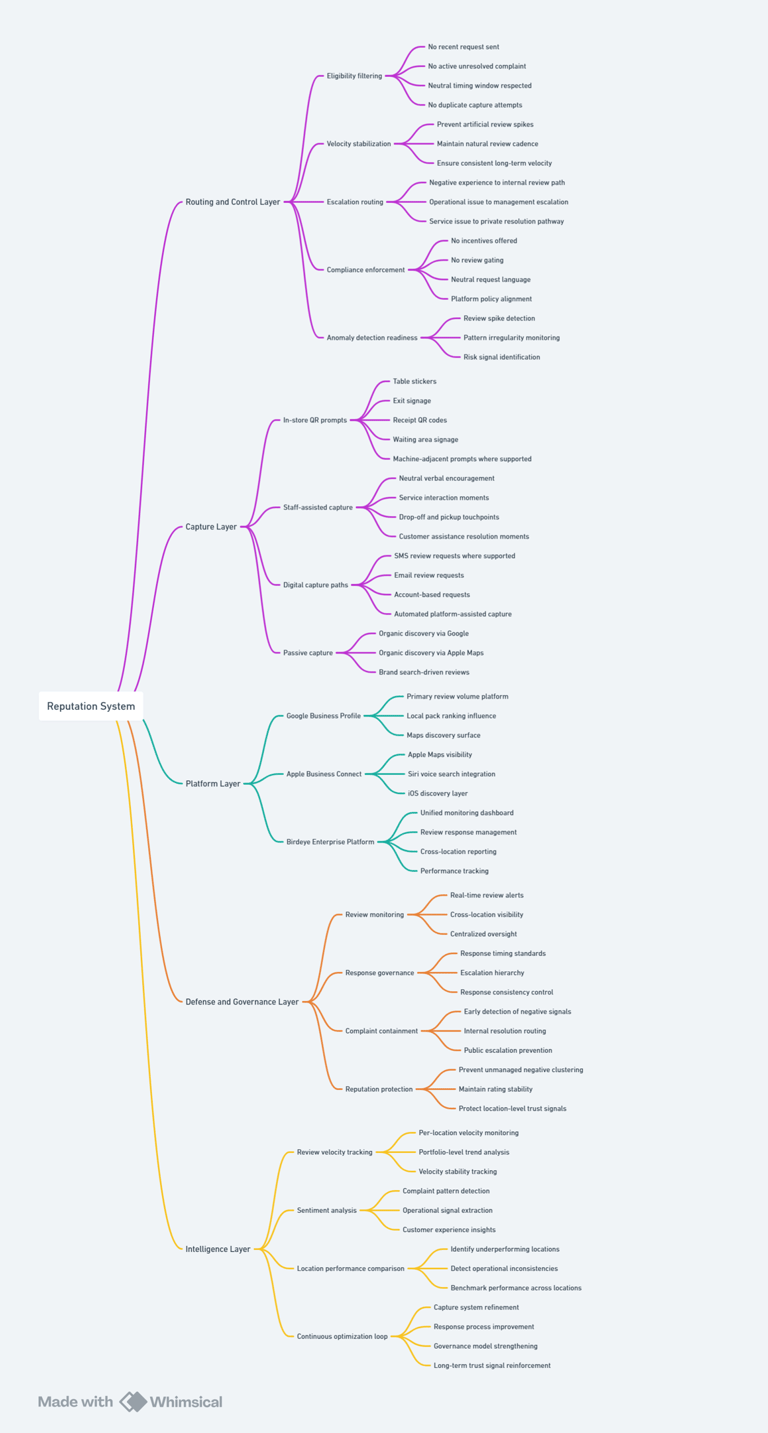
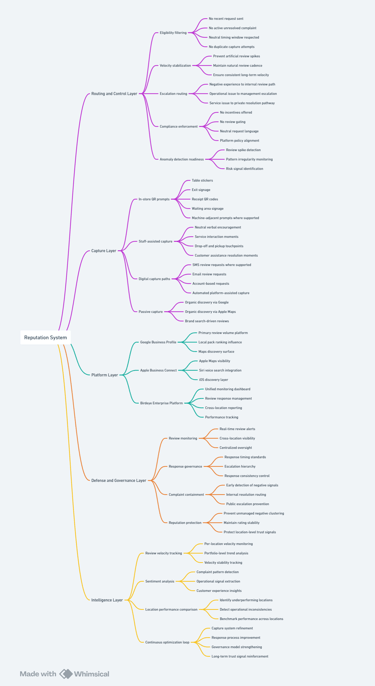
Interaction Trigger → Eligibility Control → Timing Window → Capture Path → Platform Surface → Monitoring & Intelligence
Reputation Operating System™
Designed and engineered by Allen Quay
Architecture Overview — Phase 2 Deployment Model


Layered system governing compliant capture, platform-aware routing, recovery controls, and performance intelligence.
Reputation Operating System™ — Conceptual Model
High-level system map illustrating how compliant review capture, routing control, platform governance, and intelligence layers operate together as a unified Reputation Operating System™ across multiple physical locations. Customer interactions enter through structured capture paths and are governed by compliance-aligned routing logic to ensure appropriate timing, escalation handling, and platform alignment.
Governance and monitoring layers provide centralized oversight, response control, and early detection of risk signals, while intelligence layers track review velocity, sentiment trends, and location-level performance. This closed-loop architecture transforms fragmented, staff-dependent review activity into a controlled, scalable trust infrastructure that strengthens map visibility, stabilizes reputation signals, and supports sustained multi-location growth.
Structured flow showing how customer interactions become compliant reputation signals. Eligibility control and timing logic stabilize velocity, capture paths route reviews to key platform surfaces, and monitoring layers track performance, detect risks, and enable continuous optimization across all locations.
Governance Model
To ensure consistency across locations and maintain controlled reputation signals:
Execution Owner: brand owners + CX support
Response Owner: designated responder (script-aligned)
Approval Owner: central authority (Phase-2 stabilization period)
Intelligence Owner: centralized monitoring + performance review
Governance ensured consistency in timing, tone, escalation, and cross-location visibility.
Rollout & Sequencing Strategy
To avoid destabilizing trust surfaces and triggering platform anomalies, Phase-1 launched in Recovery Mode, emphasizing:
competitor review pattern analysis
validation of compliance vs manipulation risk
velocity and signal
structual assessment
identification of operational vs system-driven gaps
determination of architecture requirements
establishment of governance-first strategy
Forensic Analysis & Strategic Assessment (completed)
This sequencing ensures stable system deployment, prevents artificial velocity spikes, and establishes sustainable, compounding reputation growth.
Phase 1
Phase 2
Reputation Operating System™ Deployment (current)
Phase 3
Ongoing Reputation Operations & Optimization (planned)
continuous monitoring and anomaly detection
response oversight and governance enforcement
review velocity stabilization and optimization
performance tracking across all locations
sentiment analysis and operational feedback loop
long-term trust signal strengthening
enterprise platform configuration
multi-location system architecture implementation
capture path deployment (QR + digital + human)
governance model activation
Google + Apple surface optimization
monitoring and escalation framework activation
Leading Indicators
Although long-term outcome metrics are still accumulating, early infrastructure signals confirm successful system activation:
These indicators confirm the Reputation Operating System™ is functioning correctly at the infrastructure and governance level.
✅ Capture paths active across all locations
✅ Review velocity stabilizing without artificial spikes
✅ Governance structure operational and enforced
✅ Monitoring and escalation visibility established
✅ Google and Apple platform alignment achieved
✅ Cross-location performance visibility enabled
✅ Compliance-first architecture fully operational
Expected Outcomes
Phase-2 outcome metrics will be measured across:
→ improved Google Maps visibility and ranking
→ increased walk-in discovery via local search
→ higher customer confidence at decision stage
→ stronger location-level trust signals
Conversion Metrics
Trust Metrics
Operational Metrics
Economic Metrics
→ star rating stabilization across locations
→ increased review velocity consistency
→ improved response coverage and timing
→ reduced unmanaged negative clustering
→ centralized monitoring across all locations
→ faster escalation and resolution workflows
→ improved location-level accountability
→ reduced reactive reputation management
→ increased walk-in traffic from map visibility
→ improved location-level revenue stability
→ stronger foundation for location expansion
→ increased long-term portfolio asset value
Attribution
Reputation Operating System™ designed by Allen Quay
Start With a Diagnostic Audit
Organizations begin with a Diagnostic Audit to quantify rating risk, map system gaps, and determine the appropriate system components for deployment





Review Dingo - Allen Quay | © Copyright 2025 | All Rights Reserved