
Case Study
Multi-Brand E-Commerce
Reputation Operating System™ for AU Multi-Brand E-Commerce Operator
Phase-1: Trust Recovery System Architecture & Deployment
Bedding + Wellness
Australia
Phase-1: Recovery System
E-Commerce Portfolio Operator
Executive Summary
An Australia-based multi-brand e-commerce operator in the bedding and wellness categories engaged Allen Quay to design and deploy a compliance-driven reputation system to improve trust signals across key purchase decision surfaces. The operator experienced fragmentation across review platforms, negative sentiment concentration on public review sites, and insufficient routing of complaints through controlled channels.
Phase-1 focused on trust recovery rather than review growth. The solution implemented a Reputation Operating System™ leveraging Shopify → Klaviyo → Birdeye integration with metric-triggered request logic, feedback routing, recovery safeguards, governance alignment, and sentiment intelligence. Early indicators confirm system integrity and controlled request velocity. Outcome metrics (Phase-2) are expected as the system moves from recovery mode into stabilization.
→ Trust Recovery vs Growth Mode
→ Metric-Triggered Architecture
→ Multi-Brand Cloning Approach
Key Insights
Industry: Bedding + Wellness
Client Context


Geography: Australia


Brands: 2 active, 2 planned


Volume: ~5,400 orders/month


Channels: Shopify + Klaviyo + Birdeye
Operator Model: Multi-brand Ecom
Operator Model:
Multi-brand e-commerce portfolio (2 active brands, 2 planned expansion)
Categories:
Bedding + wellness consumer goods
Geography:
Australia-focused distribution
Channels & Stack:
Shopify (transaction layer)
Klaviyo (marketing automation)
Birdeye (review + CX insights)
Loox (in-site reviews)
Email-only review requests (SMS deferred)
Order Volume:
Approximately 180 orders/day combined (≈5,400/month)
Trust Constraints & Business Implications
Prior to engagement, issues surfaced at the intersection of customer experience and public trust:
Low star ratings on review platforms
High negative sentiment concentration
Complaint-to-praise imbalance
Response gaps on public platforms
Platform fragmentation (multiple review surfaces)
Regulatory-style complaint language (inferred from disputes)
Trust Constraints
Business Implications
Reduced purchase confidence during evaluation
Higher refund/chargeback friction events
Increased support load (reactive CX)
Lower perceived product credibility
Slower brand expansion viability across portfolio
In consumer e-commerce, trust erosion manifests economically through:
→ hesitation at checkout
→ increased pre-purchase contact burden
→ higher perceived risk → reduced conversion confidence
→ CAC inefficiency (paid acquisition becomes wasteful)
Improving trust surfaces was therefore a prerequisite for sustainable scaling.
The operator demonstrated Maturity Level B (Patchwork/Fragmented) with:
Strengths:
high transaction volume (review-eligible)
multi-brand expansion roadmap
willingness to operationalize CX
Shopify + Klaviyo is already in place
Gaps:
− no unified review request system
− no velocity constraints or compliance gates
− no complaint routing layer
− no governance model for response handling
− fragmented platform presence (TP/PR/Loox)
− no consolidated monitoring or insights pipeline
These gaps prevented the operator from converting their natural order volume into trust capital.
Initial Maturity Assessment


Low → Patchwork → Structured → Optimized
Maturity Scale
Diagnostic Findings
Platform Surface Fragmentation
Reviews are dispersed across:
Trustpilot
ProductReview (AU)
On-site reviews (Loox)
Email
Platform with inconsistent ownership and visibility.
High-level diagnostic audit identified four core issue clusters:
Sentiment & Complaint Patterns
Themes identified:
refund friction
product expectation mismatch
delivery expectations
chargeback disputes (bank escalation semantics)
non-response signaling
These patterns shifted consumer perception from “quality risk” to “contractual/credibility risk.”


Response Gaps
Review responses were:
delayed or absent
non-standardized
lacking brand voice governance
This created a narrative imbalance favoring negative sentiment.


Lack of Routing Mechanisms
Misaligned routing:
no private resolution path
complaints escalated to public platforms
lost recovery & retention opportunities
Complaints were being posted directly to public platforms when a private resolution was available but not presented as a structured path.
Solution Design
compliance
recovery mode
routing
Reputation Operating System™ Key Elements
velocity control
platform strategy
multi-brand cloning
System Architecture
Phase-1 architecture showing metric-triggered request logic, routing, and CX governance integration.
Core Design Principles:
recovery mode vs growth mode distinction
metric-triggered request logic
eligibility & refund gating
platform compliance alignment
neutral request language
private resolution off-ramp
no incentives
no sentiment targeting
email-first sequencing
delayed SMS activation (Phase-2 option)
Technical Stack Integration:
Shopify → Klaviyo → Birdeye
Flow Structure:
Trigger: Fulfilled order in Shopify
Eligibility Filters:
• consent confirmed
• refund = false
• no prior requestDelay: 14-day post-fulfillment
Metric Pathing:
• negative experience → support resolution path
• positive/neutral → review request pathDestination:
• initial platform: Trustpilot
• ProductReview planned for Phase-2 cadenceMonitoring: queue, sent, clicked


Trigger → Eligibility → Delay → Routing → Platform → Monitoring
Reputation Operating System™
Designed and engineered by Allen Quay
Architecture Overview — Phase 1 Deployment Model
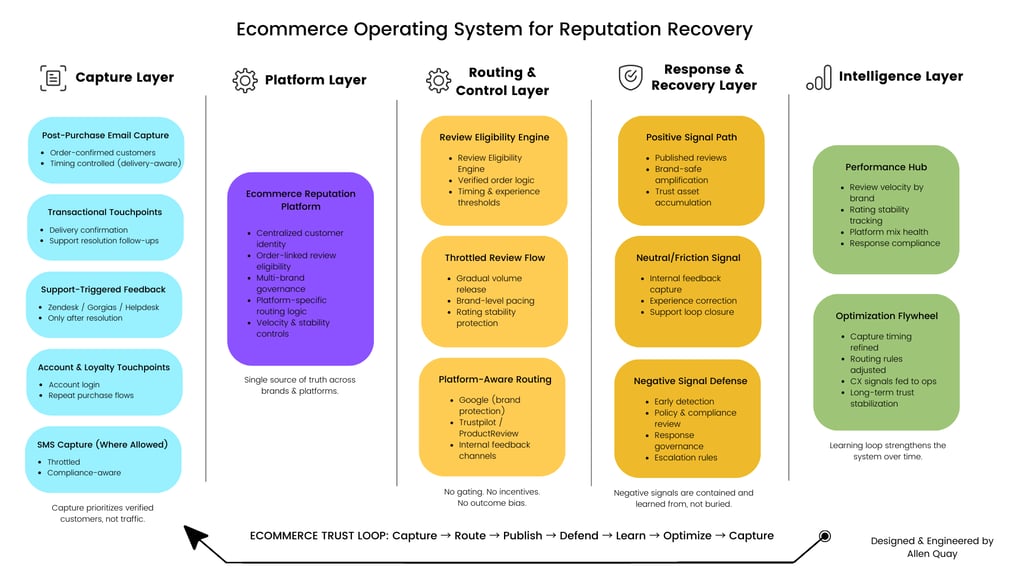
Layered system governing compliant capture, platform-aware routing, recovery controls, and performance intelligence.
Reputation Operating System™ — Conceptual Model
High-level system map illustrating how compliant review capture, routing logic, recovery controls, and governance layers interact across brands and platforms.
Governance Model
To prevent narrative asymmetry and ensure operational continuity:
Execution Owner: brand owners + CX support
Response Owner: CX agent (scripted)
Approval Owner: brand owners (Phase-1)
Insights Owner: shared, review cadence TBD
Governance reduced variance in tone, timing, and escalation behavior.
Rollout & Sequencing Strategy
To avoid destabilizing trust surfaces and triggering platform anomalies, Phase-1 launched in Recovery Mode, emphasizing:
controlled request velocity
no incentives
staggered review volume
email-only channel
no SMS acceleration
phased platform expansion (TP → PR later)
no product SKU targeting (Phase-2 optional)
no sentiment-based targeting
Recovery Mode (now)
This sequencing prevents volume spikes that can generate platform scrutiny or distort sentiment baselines.
Phase 1
Phase 2
Stabilization (later)
Phase 3
Growth Mode (optional)
Leading Indicators
Although outcome metrics are pending, early integrity signals confirmed system correctness:
These indicators demonstrate that the system is functioning as intended at the infrastructure level.
✅ Queue formation using eligibility logic
✅ Sends staggered based on fulfillment timing
✅ Complaint deflection via private path
✅ Increased internal visibility across platforms
✅ Governance compliance on responses
✅ Brand cloning repeatability for expansion
✅ Platform neutrality maintained (no policy risk)
Expected Outcomes
Phase-2 outcome metrics will be measured across:
→ reduced pre-purchase risk perception
→ increased purchase confidence
→ reduced need for support intervention pre-checkout
Conversion Metrics
Trust Metrics
Operational Metrics
Economic Metrics
→ star rating stabilization
→ increased high-quality review volume
→ reduced public complaint frequency
→ response coverage improvement
→ reduced refund/chargeback friction
→ CX load balancing via routing
→ improved escalation discipline
→ improved paid CAC efficiency (marketing ROI)
→ reduction in wasted acquisition spend
→ increased portfolio expansion viability
Attribution
Reputation Operating System™ designed by Allen Quay
Start With a Diagnostic Audit
Organizations begin with a Diagnostic Audit to quantify rating risk, map system gaps, and determine the appropriate system components for deployment





Review Dingo - Allen Quay | © Copyright 2025 | All Rights Reserved