The challenge
Good care did not automatically become visible feedback.
LifeCare Dental started the documented engagement with 67 Google reviews and a 3.7-star rating. The practice wanted a more consistent way to hear from patients after treatment, monitor the public review profile, and follow up on concerns.
For a dental practice, the process also has to respect patient privacy: an invitation to share feedback cannot become a public discussion of someone's care.
The approach
Make feedback routine, then adjust when the workflow creates friction.
The archived materials describe an initial email-based request process and review monitoring, followed by a later SMS test. Allen's role was to consult on the reputation system and its use by the practice.
Ask after the visit
The practice began sending post-treatment email feedback requests so patients had a convenient way to share their experience.
Watch the feedback
Review activity and patient comments were monitored so the team could see praise, concerns, and service issues in one operating rhythm.
Test SMS carefully
A later SMS phase increased response volume. Timing problems caused complaints, and the practice paused the feature while the scheduling issue was addressed.
The results
A clear first-month improvement, then a higher-volume SMS phase.
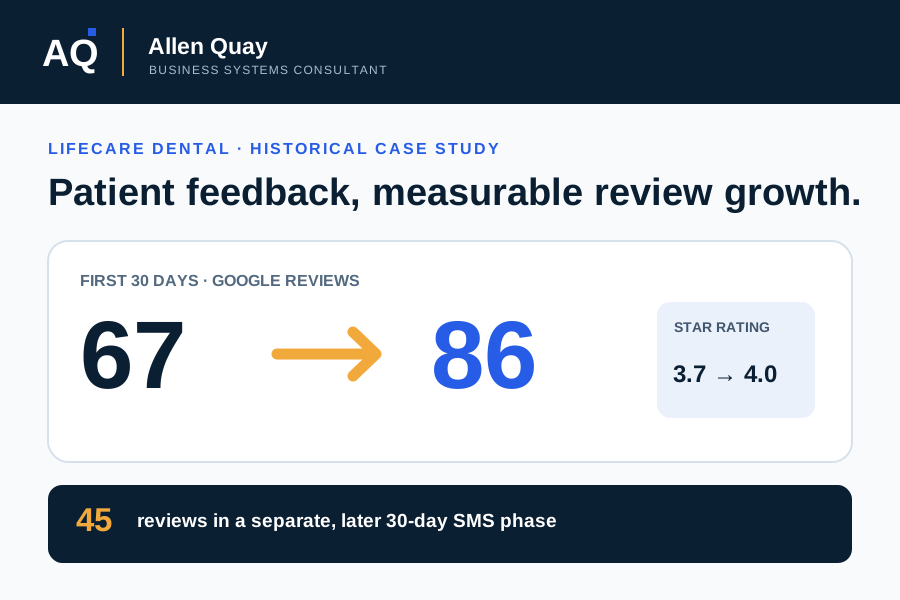
In the first 30 days, the documented Google review count rose from 67 to 86 and the displayed rating moved from 3.7 to 4.0 stars. The case-study narrative reports 19 positive reviews in that initial period.
In a separate later 30-day period, SMS requests were associated with 45 Google reviews. A later checkpoint in the archived case study recorded 273 Google reviews at 4.5 stars. The broader platform screenshots show 1.3K reviews, a 4.7 average rating, and a 74.1 NPS; those platform figures should not be read as current Google-profile metrics.
The archived dashboard also displayed an NPS of 74.1, with 80.4% promoters, 13.3% passives, and 6.3% detractors. This is a platform snapshot, not a measured change attributable solely to review requests.
Healthcare safeguards
Patient privacy and honest review requests come first.
LifeCare Dental is in Australia, where health-information handling is subject to Australian privacy requirements. This historical case study does not establish that the original system met any particular legal or platform-policy standard. The public examples here contain no patient-identifiable feedback.
For a present-day healthcare program, requests should invite honest feedback from eligible patients without filtering by sentiment, and public replies should not reveal or confirm treatment details. Messaging consent, opt-outs, timing, data access, retention, and vendor agreements require a practice-specific review.
HIPAA for U.S. work: HIPAA does not automatically govern this Australian practice. If an Allen Quay project involves a U.S. covered entity or business associate, the workflow must be assessed under the applicable HIPAA rules before protected health information is handled, including a business associate agreement where required. This case study is not a claim of HIPAA certification or a compliance guarantee.
Evidence notes
What the source materials support.
- The first-month 67-to-86 count and 3.7-to-4.0 rating comparison come from the archived narrative and presentation. The 45-review SMS result belongs to a later 30-day period; it is not part of the first-month total.
- The 273-review / 4.5-star checkpoint is from the historical narrative. The 1.3K / 4.7 and 74.1 NPS figures come from later platform screenshots and are not presented as current Google metrics.
- The source materials describe a past feedback funnel and make a search-ranking attribution that cannot be independently established here. Neither is presented as a current tactic or a proven causal result.
- The original screenshots contain dates; the branded graphic removes visible date labels for clarity while this page explicitly identifies the engagement and results as historical.
- Privacy and review-request practices must be checked against current rules. See the Australian privacy guidance, U.S. HIPAA applicability guidance, and Google review-content policy.